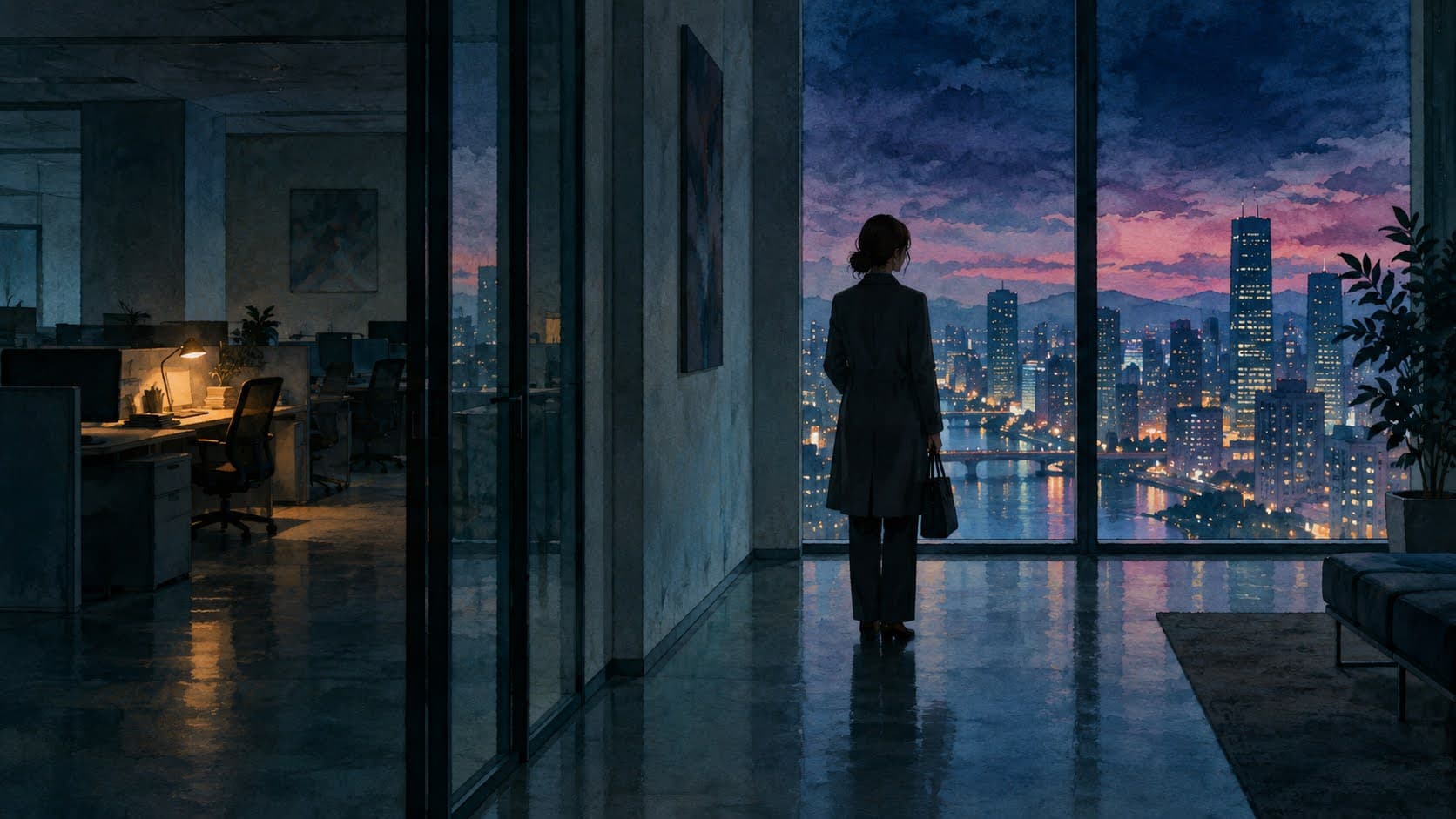
Sussurio is a place where you receive one quiet suggestion a day — a whisper — for the moments when you find yourself unsure. Behind each whisper there is no random algorithm, and no borrowed book of nice sayings. There is the Vietnamese I Ching: a southern school of a thousand-year-old art, reading the same sixty-four hexagrams the world knows, in a way the world has never really been told about.
How does Sussurio work?
It is as simple as a small ritual at the start of the day: you bring an honest question, you cast once, and a card comes back to you.
Each card is a watercolor painting, and with it comes a short whisper: where you seem to be standing, which way the moment leans, and one quiet line to carry with you through the day. It does not tell your fortune. It does not promise a future. It simply offers you an angle you had not tried, right at the moment you need it most.
One day, one cast. The universe whispers — whether you listen is up to you.
Where do the whispers come from?
This is where Sussurio differs from every card-pulling app you have seen.
Every whisper is distilled from one of the sixty-four hexagrams of the I Ching, the ancient "Book of Changes" that the East has used to read human situations for thousands of years. But Sussurio does not read those sixty-four hexagrams the familiar northern way.
We read them through the Vietnamese I Ching, a school preserved in the south and systematized today under the name Hùng Việt. The same sixty-four hexagrams, but this school changes some of the most fundamental conventions of the old reading, and when the place you stand changes, the whole map changes with it. What changes, and why — that is a story told slowly, inside each card.
The Vietnamese five elements: no Earth, no Metal
Let us open the door just a crack, so you can see how different this school really is.
The five elements the world knows are Metal, Wood, Water, Fire and Earth. The Vietnamese five elements? There is no Earth. There is no Metal. In their place stand Stone, the crystallized and enduring one that carries the memory of time, and Wind, the one you cannot see or hold and yet it touches everything, sitting at the very center of the wheel.

A daily divination app with no coins, and no deck to shuffle
Sussurio inherits the casting method of the famous Mai Hoa school, sometimes called the Plum Blossom method: the hexagram arises from time itself. The moment your question takes shape already carries the answer within it.
That is what makes an i ching reading without coins possible. No props. No ritual. No theory to memorize. The philosophy behind it is quietly beautiful: the answer is not somewhere outside you — it is stamped into the very moment you dare to ask.

What can you actually ask it?
Almost anything you would ask a friend who listens well, and nothing you would ask a psychic.
The Vietnamese I Ching is not built to answer questions like will I get the job or will they come back. It is built for the other kind, the ones that keep you awake: should I keep trying here, or is this the moment to let go? Am I being patient or just stubborn? Why does something that looks fine on paper feel so heavy to carry?
Questions like these do not have a single right answer waiting somewhere. What they have is a shape, a position, a direction the moment is leaning in. That is what a hexagram describes: not what will happen, but where you are standing and what tends to follow when someone stands there. The rest is yours to decide.
A small habit helps. Ask one honest question a day, read the whisper, then go about your day without arguing with it. Come back a week later and read the ones you kept. People are often surprised by which lines turned out to be about something they had not admitted yet.
Why try the Vietnamese I Ching, even if you have never believed in divination?
Because Sussurio does not ask you to believe. It only invites you to look at your own situation from an angle you have not tried.
People turn to tarot, astrology or the I Ching not really because they want to know the future, but because in moments of doubt, everyone needs a mirror tilted a few degrees. Sussurio is that mirror, ground from a school of thought a thousand years deep, dressed in soft watercolor, and speaking the everyday language of your own life.
Most people arrive here carrying one particular question. If yours is about a relationship that has gone quiet, there is a piece on how to know when to walk away from a relationship; and if everything seems fine but your heart has not settled, there is one on how to know if someone is right for you. If it is about work, there is another on the signs it's time to leave your job. And if you are standing in front of a choice you cannot seem to settle, there is one on how to make a hard decision. All four are written the same way a whisper is: no verdict, just a clearer view.
The decision, in the end, always remains yours.
Quick questions, quiet answers
Is Sussurio a fortune-telling app?
Not in the sense of predicting your future. Sussurio is a daily divination app in the older, gentler meaning of the word: it offers suggestions, a fresh angle on where you stand, and the choice always stays in your hands.
Is the Vietnamese I Ching the same as the Chinese I Ching?
They share the same root of sixty-four hexagrams, but the Vietnamese school is an independent southern tradition that reads several core conventions in its own way.
Do I need to know anything about the I Ching first?
Nothing at all. Every layer of theory has been distilled into plain, everyday whispers. All you bring is your question.
How is Sussurio different from a tarot app?
If you are looking for alternatives to tarot, this is a different tradition altogether. Tarot draws from seventy-eight Western cards. Sussurio casts from the sixty-four hexagrams of a southern school of the I Ching never before told in English, with guidance written for modern life.
Why is it called Hùng Việt?
The name honors the era of the Hùng Kings, a way of saying that the south has its own current of the I Ching, not a copy of the north's. You will also see this school written as the Hung Viet I Ching, without the diacritics.